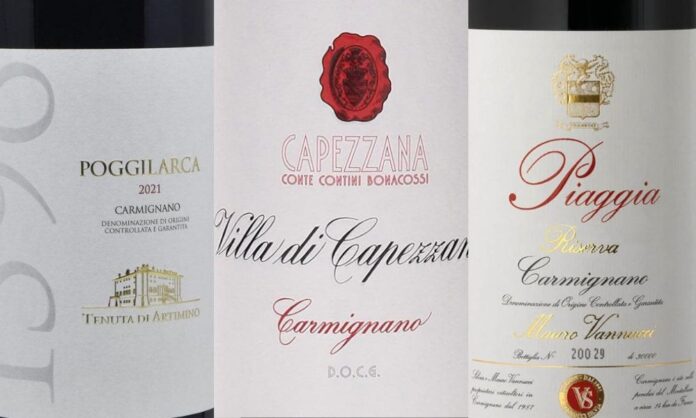
Discover our selection of the best Carmignano wines recommended by Jean Marco Palmieri, complete with photos, descriptions and tasting notes.
Best Carmignano DOCG Wines Recommended by Jean Marco Palmieri
Which are the best Carmignano wines?
Explore our updated selection of the best Carmignano wines, with photos and detailed descriptions to help you discover producers whose wines suit your taste.
Villa di Capezzana Carmignano DOCG – Capezzana
The nose reveals ripe cherry, blackcurrant and violet, complemented by tobacco and spice. The palate shows good structure, firm tannins and well-integrated acidity, leading to a persistent finish with lingering fruit and spice notes.
Technical notes: Vineyards on the hills of Carmignano, with soils characterised by clay shale. Vinification in stainless steel and maturation in wood, using both tonneaux and larger casks. Organic vineyard management.
Grape varieties: Sangiovese, Cabernet Sauvignon.
Poggilarca Carmignano DOCG – Tenuta di Artimino
The nose offers cherry, plum and violet, with spicy and slightly herbaceous nuances. The palate is medium-bodied, with fine-grained tannins and good freshness, showing balanced development and a lingering finish.
Technical notes: Vineyards on moderately calcareous soils containing stones and sedimentary material. The grape varieties are vinified separately in stainless steel, followed by 12 months of maturation in large casks and barriques, then further ageing in bottle.
Grape varieties: Sangiovese 85%, Cabernet Franc 15%.
Piaggia Carmignano DOCG Riserva – Piaggia
The nose reveals blackberry, blackcurrant and ripe cherry, accompanied by tobacco, cocoa and spice. The palate is full-bodied, with good extract concentration and dense tannins supported by balanced acidity. The finish is long, with lingering dark fruit and spice notes.
Technical notes: Grapes from the estate’s vineyards in the Piaggia area, on clay soils containing galestro. Hand harvesting, separate vinification of the grape varieties and fermentation without the addition of selected yeasts.
Grape varieties: Sangiovese, Cabernet Sauvignon, Cabernet Franc, Merlot.
Santa Cristina in Pilli Carmignano DOCG – Fattoria Ambra
The nose offers cherry, red plum and violet, accompanied by spicy and balsamic nuances. The palate is medium-bodied, with good acidity and well-integrated tannins, showing balanced development and a finish marked by red fruit notes.
Technical notes: Vineyards in Santa Cristina in Pilli, at approximately 150 metres above sea level, on alberese limestone soils. Maceration lasts 15–20 days, with pump-overs and délestage. Ageing for approximately one year in French tonneaux and large Slavonian oak casks. Organic vineyard management.
Grape varieties: Sangiovese 75%, Canaiolo Nero 10%, Cabernet 10%, other red grape varieties 5%.
Sancti Blasii Carmignano DOCG – Colline San Biagio
The nose unfolds with sour cherry, blackberry and ripe plum, accompanied by tobacco, vanilla and sweet spice. The palate is full-bodied, with good concentration and ripe tannins, supported by acidity that sustains its structure. The finish is persistent, with lingering fruit and spice notes.
Technical notes: Vineyards on galestro and alberese soils, trained to spur-pruned cordons at a density of approximately 5,000 vines per hectare. Temperature-controlled fermentation in stainless steel, malolactic fermentation in barriques and ageing in French oak for 12–15 months, followed by a period in bottle.
Grape varieties: Sangiovese 70%, Cabernet Sauvignon 20%, Merlot 10%.
Carmignano DOCG – Tenuta di Castelvecchio
The nose offers ripe cherry, plum and violet, accompanied by nuances of tobacco, spice and forest floor. The palate is medium- to full-bodied, with firm tannins and balanced acidity. The finish is persistent, with lingering red fruit and spice notes.
Technical notes: Vineyards on the hills of Carmignano, with hand harvesting and grape selection. Maturation in oak casks, including Allier oak tonneaux, followed by ageing in bottle.
Grape varieties: Sangiovese, Cabernet Sauvignon.
Carmignano DOCG Riserva – Le Farnete
The nose reveals sour cherry, ripe plum, blackcurrant and tobacco, accompanied by vanilla and sweet spice. The palate is full-bodied, with good extract concentration and polished tannins supported by balanced acidity. The finish is persistent, with lingering ripe fruit and spice notes.
Technical notes: Vineyards in the Comeana area, at approximately 150 metres above sea level, on soils characterised by alberese limestone and clay. Approximately 30-year-old vines trained to spur-pruned cordons. Temperature-controlled vinification in stainless steel, maturation for 12 months in new barriques and a further 12 months of ageing in bottle.
Grape varieties: Sangiovese 80%, Cabernet Sauvignon 20%.
Terre a Mano Carmignano DOCG – Fattoria di Bacchereto
The nose offers cherry, redcurrant and blackberry, accompanied by floral notes, aromatic herbs and spice. The palate shows good concentration, vibrant acidity and assertive tannins, with a well-defined structure and a persistent finish marked by fruit and balsamic notes.
Technical notes: Vineyards on the slopes of Montalbano, between 180 and 300 metres above sea level, on soils characterised by alberese limestone, clay shale and sandstone. Biodynamic vineyard management, hand harvesting and spontaneous fermentation in glass-lined concrete tanks. Maturation in 350-litre Allier oak tonneaux, followed by ageing in bottle.
Grape varieties: Sangiovese, Cabernet Sauvignon, Canaiolo Nero.
Which Is the Best Carmignano Wine?
Which are the best Carmignano wines? Choosing is a difficult task, inevitably constrained by subjective opinion, which, by its very nature, is partial and arbitrary.
We have simply compiled a selection of our favourite interpretations, based on our own assessments. Yet it is essential to remember that wine is not meant to be a status symbol, displayed or flaunted for all to see.
It is meant to move us and to be shared sincerely with the people we love, becoming part of the unique circumstances and intimate, unrepeatable moments of our lives.
We therefore encourage you to visit the producers who craft these distinctive wines, so that you can discover and decide for yourself which deserve a place among your personal favourites.
If you have had the patience to read this far, thank you for your attention. Now, however, it is time to fill our glasses and let go of distant hopes. And so:
Cheers, Salute, Santé
Jean Marco Palmieri